
rsteelesr79
50-Year Mortgage Explained: Pros, Cons, Tax Savings & Comparison to 15, 30, 40-Year Loans
The 50-year mortgage is a bold proposal aimed at lowering monthly payments,
but it comes with significant long-term costs and risks.
What Is a 50-Year Mortgage?
A 50-year mortgage is a fixed-rate home loan stretched across five decades—600 monthly payments compared to the 360 payments of a traditional 30-year mortgage. The idea was recently floated by President Donald Trump and Federal Housing Finance Agency Director Bill Pulte as a way to address the housing affordability crisis.
Why It’s Being Proposed
- Housing affordability crisis: Home prices remain high, interest rates elevated, and inventory tight.
- Lower monthly payments: By spreading costs over 50 years, borrowers could save $2,000 annually compared to a 30-year loan.
- Access to homeownership: Supporters argue it could help younger buyers and those struggling to qualify for traditional loans.
⚠️ Risks and Criticisms
- Equity builds slowly: Most payments in the first decade go toward interest, leaving homeowners vulnerable if prices fall.
- Higher lifetime costs: Borrowers would pay hundreds of thousands more in interest over the life of the loan.
- Default risk: With limited equity, homeowners face greater risk of foreclosure during economic downturns.
- Banks may raise rates: Lenders could offset risk by charging higher interest, erasing much of the monthly savings.
- Doesn’t fix supply issues: Critics argue it’s a band-aid solution that doesn’t address the root problem—too few homes on the market.
Example: 30-Year vs. 50-Year
| Loan Term | Monthly Payment (Approx.) | Total Interest Paid | Equity Growth |
|---|---|---|---|
| 30-Year | Higher | Lower | Faster |
| 50-Year | Lower | Much Higher | Slower |
Sources:
What It Means for Buyers
The 50-year mortgage could make homeownership more accessible in the short term, especially for first-time buyers squeezed by high prices. But the trade-off is long-term debt, slower wealth-building, and higher overall costs. For many, it may feel like renting from the bank for life rather than owning a home outright.
️ Key Perspectives on the 50-Year Mortgage
| Person / Group | Position / Statement | Tone / Implication |
|---|---|---|
| Donald Trump (President) | Floated the idea on Truth Social, calling it a way to lower monthly payments and help young people buy homes | Supportive, framing it as part of the “American Dream” |
| Bill Pulte (FHFA Director) | Called it a “complete game changer” and said the agency is working on it | Strongly supportive, presenting it as a bold affordability solution |
| White House Officials (anonymous sources) | Some said Trump was lukewarm and only announced it to quiet Pulte; others confirmed discussions of 40- and 50-year terms | Mixed, with internal disagreement and frustration over rollout |
| Conservative Allies of Trump | Expressed skepticism, warning it could benefit banks more than buyers and increase total interest costs | Critical, worried about long-term debt burden |
| Housing Industry Experts | Warn that savings would be minimal, equity would build very slowly, and borrowers would pay hundreds of thousands more in interest | Cautious to negative, highlighting risks over benefits |
| Public Reaction (online commentators) | Many criticized the idea as increasing debt levels and failing to fix supply issues | Negative, viewing it as a band-aid solution |
Takeaway
The 50-year mortgage is being promoted by Trump and Bill Pulte as a way to expand access to homeownership, especially for younger buyers. But critics—including some within Trump’s own circle—argue it’s financially risky, benefits banks more than families, and doesn’t solve the housing supply crunch.
Loan Comparison: $300,000 Mortgage at 6% Interest
| Loan Term | Monthly Payment | Total Paid Over Life | Total Interest Paid | Equity Growth Speed |
|---|---|---|---|---|
| 15-Year | ≈ $2,530 | ≈ $455,000 | ≈ $155,000 | Very fast – builds equity quickly |
| 30-Year | ≈ $1,800 | ≈ $648,000 | ≈ $348,000 | Moderate – standard equity growth |
| 40-Year | ≈ $1,650 | ≈ $792,000 | ≈ $492,000 | Slow – equity builds much later |
| 50-Year | ≈ $1,580 | ≈ $948,000 | ≈ $648,000 | Very slow – equity builds extremely late |
Key Takeaways
- Monthly Relief: The 50-year loan cuts payments by about $950 compared to a 15-year loan.
- Long-Term Cost: That relief comes at a steep price—interest nearly quadruples compared to a 15-year loan.
- Equity Risk: With 40- and 50-year loans, homeowners spend decades paying mostly interest, leaving them vulnerable if housing prices dip.
- Wealth Building: Shorter terms (15-year) are far better for building equity and reducing lifetime debt.
Mortgage Term Comparison on a $300,000 Loan (6% Interest)
| Loan Term | Monthly Payment | Total Interest Paid | Pros | Cons |
|---|---|---|---|---|
| 15-Year | ≈ $2,530 | ≈ $155,000 | – Builds equity fastest – Lowest total interest – Own home sooner |
– Highest monthly payment – Harder to qualify due to income requirements |
| 30-Year | ≈ $1,800 | ≈ $348,000 | – Standard option, widely available – Balanced monthly payment – Easier to qualify |
– Pays more than double the interest of 15-year – Slower equity growth |
| 40-Year | ≈ $1,650 | ≈ $492,000 | – Lower monthly payment than 30-year – Expands affordability for buyers |
– Much higher lifetime interest – Very slow equity buildup – Limited availability |
| 50-Year | ≈ $1,580 | ≈ $648,000 | – Lowest monthly payment – Makes homeownership accessible for more buyers – Short-term affordability relief |
– Enormous interest burden – Equity builds extremely slowly – Riskier if housing prices fall – May feel like “renting from the bank” |
Big Picture
- Shorter terms (15-year) → Best for wealth-building, lowest cost, but hardest to afford monthly.
- Middle ground (30-year) → Most common, balances affordability and long-term cost.
- Extended terms (40- and 50-year) → Lower monthly payments, but huge long-term debt and slow equity growth.
Possible Tax Savings with a 50-Year Mortgage
One of the few potential upsides of a longer mortgage term is the mortgage interest deduction available to many U.S. taxpayers. Here’s how it could play out:
How It Works
- Mortgage Interest Deduction: Homeowners who itemize deductions can subtract mortgage interest payments from taxable income.
- Longer Terms = More Interest: A 50-year loan front-loads interest payments, meaning borrowers pay interest for decades before significantly reducing principal.
- Tax Benefit: Higher interest payments in the early years could lead to larger deductions, lowering taxable income.
✅ Potential Advantages
- Bigger deductions in early years: Since most of the payment is interest, itemizers may see more tax savings initially.
- Extended deduction period: With interest stretched over 50 years, homeowners could benefit from deductions for a much longer time.
- Helps cash flow: Lower monthly payments plus tax savings could ease financial strain for some households.
⚠️ Limitations
- Standard deduction hurdle: Many taxpayers don’t itemize because the standard deduction is higher; in those cases, the mortgage interest deduction provides no benefit.
- Long-term cost outweighs savings: The extra interest paid over 50 years far exceeds any tax benefit.
- Policy uncertainty: Tax laws can change, so relying on deductions decades into the future is risky.
- Equity trade-off: Even with tax savings, homeowners build equity very slowly, limiting wealth creation.
Bottom Line
While the 50-year mortgage could generate larger and longer-lasting tax deductions, the overall financial burden is still much heavier than shorter loans. Tax savings may soften the blow, but they don’t erase the fact that borrowers pay hundreds of thousands more in interest.
Perfect — let’s illustrate how tax savings from mortgage interest deductions could look across different loan terms for a $300,000 loan at 6% interest.
⚠️ Note: These are simplified estimates assuming the borrower itemizes deductions and is in a 22% federal tax bracket. Actual savings depend on tax law changes, income, and whether the standard deduction is higher than itemized deductions.
Estimated Tax Savings by Loan Term (First-Year Interest Deduction)
| Loan Term | Monthly Payment | First-Year Interest Paid | Estimated Tax Savings (22% Bracket) | Long-Term Deduction Pattern |
|---|---|---|---|---|
| 15-Year | ≈ $2,530 | ≈ $17,800 | ≈ $3,900 | Declines quickly as principal is paid down |
| 30-Year | ≈ $1,800 | ≈ $17,950 | ≈ $3,950 | Moderate decline, deductions last ~20–25 years |
| 40-Year | ≈ $1,650 | ≈ $17,980 | ≈ $3,955 | Very slow decline, deductions extend ~30+ years |
| 50-Year | ≈ $1,580 | ≈ $17,990 | ≈ $3,958 | Extremely slow decline, deductions extend nearly lifetime |
Key Insights
- First-year savings are nearly identical across all terms because interest dominates early payments.
- Shorter loans (15-year): Tax savings taper off quickly as principal is paid faster.
- Longer loans (40- and 50-year): Tax deductions last decades longer, but this comes at the cost of hundreds of thousands more in interest overall.
- Net effect: The tax benefit is real but doesn’t outweigh the massive extra interest paid on ultra-long loans.
This table shows why the 50-year mortgage might look appealing for tax deductions in the short run, but the long-term financial trade-off is steep.
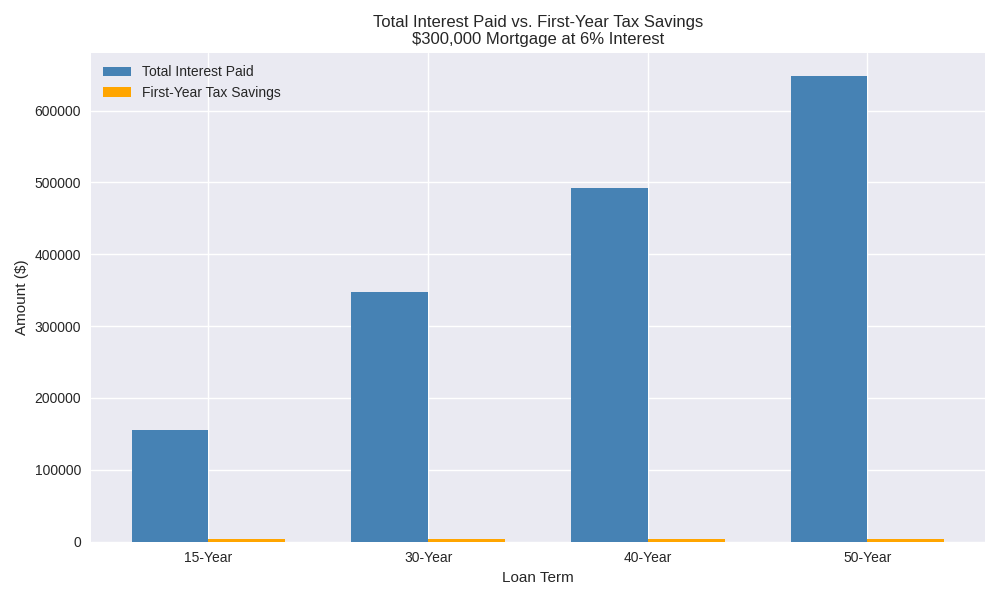
What the Chart Shows
- Blue bars = Total interest paid over the life of the loan
- Orange bars = First-year tax savings from mortgage interest deduction (22% bracket)
- Key Insight: While tax savings are nearly identical across terms (~$3,900 in year one), the interest burden skyrockets as the loan term lengthens.
Breakdown
- 15-Year Loan: ~$155k interest vs. ~$3.9k tax savings → best for wealth-building.
- 30-Year Loan: ~$348k interest vs. ~$3.95k tax savings → balanced but costly.
- 40-Year Loan: ~$492k interest vs. ~$3.96k tax savings → affordability trade-off.
- 50-Year Loan: ~$648k interest vs. ~$3.96k tax savings → tax benefit dwarfed by debt.
Takeaway
The chart makes it clear: tax deductions don’t scale with the exploding interest costs. The 50-year mortgage offers extended deductions, but the long-term debt burden far outweighs the benefit.
BEST TIME TO SELL A HOUSE
Best Time to Sell a House: Seasonal Insights for Maximum Profit
Is there really a “best” time to sell a house? The short answer: Yes—but it depends.
While market trends suggest that spring and summer are generally the most favorable seasons, the ideal time to sell varies based on location, competition, and preparation. Let’s break down the best times to list your home, regional considerations, and key strategies to maximize your sale.
Why Timing Matters in Real Estate
Real estate markets fluctuate with the seasons, influenced by weather, buyer demand, and even school schedules. However, the “best” time isn’t universal—warmer states like Texas, Florida, and Southern California often see stronger winter sales, while colder regions peak in spring and summer.
Data shows that homes sell faster and at higher prices during peak seasons, but simply listing at the “right” time isn’t enough. You’ll also need:
✔ Proper staging and repairs
✔ Competitive pricing
✔ A skilled real estate agent (if needed)
Now, let’s explore how each season impacts home sales.
Timing your home sale right can mean thousands more in profit—or a faster closing. But the “best” time depends heavily on your local market. Below, we break down seasonal trends in key U.S. cities, including price premiums, days on market, and competition levels, plus interactive tools to track your neighborhood’s trends.
Winter: A Niche Opportunity
Best for: Warm-weather markets (Florida, Arizona) or highly desirable homes
Why? Inventory drops, but serious buyers (relocations, investors) are still looking.
Key Insights:
-
Fewer listings mean less competition.
-
Holiday-motivated buyers may move faster.
Pro Tip: If selling in winter, highlight energy efficiency (good heating, insulation) and keep walkways clear for showings.
Live Market Trackers: Check Your Local Trends
Regional Breakdowns: When to Sell for Max Profit
Northeast (Peak: April–June)
| City | Best Month | Price Premium | Avg. DOM | Key Strategy |
| New York, NY | May | +8.5% | 32 days | List condos before Memorial Day to avoid summer slowdown |
| Boston, MA | April | +7.2% | 29 days | Target academic hires near Harvard/MIT |
| Philadelphia, PA | March | +5.8% | 41 days | Staged row homes sell 12% faster |
Midwest (Peak: May–July)
| City | Best Month | Price Premium | Avg. DOM | Key Strategy |
| Chicago, IL | June | +6.4% | 25 days | Price 1–2% below market to spark bidding wars |
| Minneapolis, MN | May | +5.1% | 38 days | Highlight winter-ready features |
South (Varies: Winter in FL, Spring in TX)
| City | Best Month | Price Premium | Avg. DOM | Key Strategy |
| Miami, FL | January | +9.7% | 22 days | Waterfront peaks Dec–Feb |
| Dallas, TX | April | +5.9% | 23 days | Avoid August (DOM jumps 47 days) |
West (Spring in CA, Winter in AZ)
| City | Best Month | Price Premium | Avg. DOM | Key Strategy |
| Los Angeles, CA | May | +7.8% | 42 days | Coastal homes sell 30% faster |
| Phoenix, AZ | December | +6.4% | 27 days | List by Thanksgiving |
3 Rules to Outsmart Seasonal Trends
-
- Price Smarter Homes priced 1–3% below market in slow seasons sell 17% faster (Redfin)
-
- Stage Strategically Seasonal staging (e.g., pool towels in summer) increases offers by 3–5% (NAR)
-
- Track Hyperlocal Data Check Redfin’s “Hot Homes” for bidding war rates
Final Takeaway
While spring/summer dominate nationally, your ZIP code’s data matters more. Use the tools above to sell smart in any season.
How Long does it take to Sell a House
How Long Does It Take to Sell a House? | CanSellYourHouse.com
If you are searching for how long does it take to sell a house, you probably want more than a generic real estate explanation. You want to know what your realistic options are, what can slow the sale down, how to protect your net proceeds, and how to move forward without unnecessary repairs, showings, or pressure. This guide is written for homeowners in Virginia who want a practical, WordPress-ready explanation of the selling process.Need a simple option? CanSellYourHouse.com can review the property, explain the numbers, and give you a no-obligation cash offer so you can compare your choices clearly.
What How Long Does It Take To Sell A House Really Means
The original topic behind this page is simple: homeowners need a clear path when the normal selling process feels too slow, too expensive, or too uncertain. In practical terms, How Long Does It Take to Sell a House? If you’re asking, how long does it take to sell a house? , the quick answer is: it depends. Traditional home sales often take anywhere from a few weeks to several months. However, if you need to sell quickly, there are options available—like selling your house for cash—that can dramatically shorten this timeline.. The better approach is to compare each option by timeline, risk, required repairs, and final net proceeds. For most sellers, the phrase how long does it take to sell a house does not mean accepting the first number offered or ignoring the home’s value. It means choosing a sale strategy that matches the condition of the property and the seller’s deadline. A fully updated house with no title issues may do well on the open market. A property with repairs, tenants, liens, inherited ownership, foreclosure pressure, or a seller who has already moved may need a different plan.Common Reasons Homeowners in Virginia Want a Faster Sale
- Preparing the home for sale:*1 to 3 weeks
- Listing and marketing the property:*1 to 4 weeks
- Finding a buyer:*2 to 8 weeks
- Under contract to closing:*30 to 60 days
- Seller’s market:*High demand and low inventory often mean faster sales.
- Buyer’s market:*More homes for sale than buyers can mean longer time on market.
Your Main Selling Options
1. List the House With an Agent
A traditional listing can expose the property to retail buyers and may produce the highest contract price when the home is clean, financeable, easy to show, and priced correctly. The tradeoff is that the seller usually deals with preparation, photographs, showings, inspection negotiations, appraisal risk, buyer financing, and a closing timeline that depends on the buyer’s lender. Sellers should compare the likely list-price outcome against commissions, repair credits, mortgage payments, insurance, taxes, utilities, and the time spent waiting.2. Sell Directly to a Cash Buyer
A direct cash sale is designed for convenience and certainty. The buyer reviews the home, makes an offer based on its present condition, and closes through a title or settlement company. The seller can often avoid repairs, deep cleaning, staging, open houses, and repeated negotiation. The offer may be lower than a perfect retail list price, but the seller should compare it to the realistic net after all traditional selling costs.3. Make Repairs Before Selling
Repairs can help when the work is affordable, the scope is clear, and the finished improvements will increase buyer confidence. Repairs can also become a trap when contractors uncover more problems, permits are needed, costs rise, or the seller does not have time to manage the project. Before spending money, estimate the true return and ask whether the repairs are necessary for your buyer type.4. Hold the Property Longer
Keeping the property may be reasonable when the owner can afford payments, maintenance, insurance, taxes, and utilities. It may not be reasonable when the house is vacant, deteriorating, occupied by difficult tenants, or tied to an estate, divorce, or financial deadline. The cost of waiting is real, and it should be included in every selling decision.Important Facts for Virginia Sellers
A closing statement should show credits, debits, payoffs, taxes, recording charges, and net proceeds. The settlement agent coordinates documents, deed signing, payoff collection, and disbursement. Sellers should review wiring instructions carefully and verify them by phone using a trusted number. At closing, the settlement agent prepares the documents and settlement statement showing charges, credits, payoffs, and disbursements. Sellers should review the statement and verify wiring instructions before funds move.How to Compare a Cash Offer With a Traditional Sale
The cleanest comparison is not cash offer versus list price. The cleanest comparison is cash net today versus probable retail net later. A retail buyer may pay more on paper, but the seller may also pay commissions, seller concessions, repairs, utilities, taxes, insurance, mortgage payments, and months of carrying costs. A cash buyer may offer less on paper but create a simpler path with fewer moving parts.- Estimated retail sale price
- Realistic repair and cleanup costs
- Agent commissions and seller concessions
- Mortgage payments and carrying costs while waiting
- Inspection, appraisal, and buyer financing risk
- Closing date certainty and seller convenience
- Your stress level and available time
Documents to Gather Before You Sell
- Recent mortgage statement or loan payoff information
- Property tax bill and homeowners insurance information
- Any lease, deposit record, or rent ledger if tenants occupy the home
- Repair estimates, inspection reports, permits, or contractor invoices
- HOA or condo documents if applicable
- Probate, divorce, trust, bankruptcy, or power-of-attorney documents when ownership is complicated
- Utility information and access instructions for walkthroughs
Red Flags to Avoid
- A buyer who will not put the offer in writing
- Pressure to sign immediately without time to read the agreement
- Vague language about fees, assignments, repairs, or closing costs
- Requests to send money before closing without a clear written reason
- Promises that ignore liens, probate, tenants, or foreclosure deadlines
- No clear settlement company, title process, or closing timeline
How CanSellYourHouse.com Helps Virginia Homeowners
CanSellYourHouse.com focuses on making the selling process simple. The goal is to review the property as it sits, provide a clear cash offer, and let the homeowner decide whether that option is better than listing, repairing, renting, or waiting. There are no showings to coordinate with multiple buyers, no demand that you renovate first, and no need to make the house look perfect before the first conversation.- Request a no-obligation offer online or by phone
- Share basic property details and your preferred timeline
- Schedule a quick walkthrough or property review
- Receive a written offer and compare your options
- Close through a settlement company on a timeline that works for you
Frequently Asked Questions
Can I how long does it take to sell a house without making repairs?
In many cases, yes. An as-is cash buyer can evaluate the property in its current condition. A traditional buyer may still request repairs, credits, or inspection concessions.How fast can a cash sale close?
Timing depends on title work, payoff figures, seller readiness, and access to the property. Cash transactions can often move faster than financed sales because there is no mortgage underwriting delay.Will I pay real estate commissions?
If you sell directly to a buyer, there may be no listing commission. Always review the purchase agreement and closing statement so you understand every cost and credit.Do I have to accept the first offer?
No. A no-obligation offer should give you information, not pressure. Compare the cash number with your expected retail net after repairs, holding costs, commissions, and time.Should I talk to an attorney or tax professional?
For probate, divorce, bankruptcy, foreclosure, tax liens, or ownership disputes, professional guidance is wise before signing binding documents.Final Takeaway
The best way to how long does it take to sell a house is to compare your real options, not just the advertised price. Look at repairs, timing, title, risk, fees, and the net amount you expect to keep. A direct cash offer from CanSellYourHouse.com can give you a simple benchmark, even if you ultimately decide to list traditionally. Ready to compare your options? Contact CanSellYourHouse.com today for a no-obligation cash offer and a straightforward explanation of your next steps.Factual Sources and Disclaimer
This article is general information for homeowners and is not legal, tax, or financial advice. Verify important deadlines, ownership authority, payoff figures, and closing details with the appropriate professional.- Virginia Title 55.1, Subtitle II covers real estate settlements and settlement statements: https://law.lis.virginia.gov/vacodefull/title55.1/subtitleII/
Find The Value Of Your Home
Best Websites to Find the Value of Your Home (Reviewed and Compared)
Whether you’re thinking of selling your home, refinancing your mortgage, buying an investment property, or you’re just plain curious — knowing your home’s value is key. But what’s the real intent behind someone searching for a home’s value?
In most cases, people want to know the value of a property because they’re:
- Considering selling and want to price it right
- Looking to buy and want to compare prices
- Refinancing or taking out a home equity loan
- Evaluating rental income potential
- Appealing property taxes
- Planning renovations and want to understand ROI
Whatever your reason, online home valuation tools can provide a fast, free starting point. Below, we’ve reviewed and compared some of the best websites for finding out what your home is worth online.
Zillow
- Cost: Free
- Accuracy: Moderate
- Best For: Instant estimates and browsing nearby listings
Zillow’s Zestimate tool is arguably the most well-known online home valuation resource. With a massive database and easy-to-use app, Zillow offers quick property value estimates and allows users to browse nearby homes for sale or rent. It also lets you claim and update your property to improve accuracy. However, Zestimate figures can sometimes be off by 5–10% depending on local data.
Redfin
- Cost: Free
- Accuracy: High (uses MLS data)
- Best For: Accurate pricing and market trends
Redfin offers one of the most accurate online home valuation tools, using up-to-date MLS (Multiple Listing Service) data. You can get a detailed look at comparable homes, recent sales, and market activity. Their user interface is clean and fast, and you can connect directly with Redfin agents for a more thorough analysis.
Trulia
- Cost: Free
- Accuracy: Moderate
- Best For: Neighborhood data and affordability insights
Trulia focuses more on lifestyle factors. It gives home value estimates along with local demographic info, school ratings, crime maps, and more. Their affordability calculator is a helpful tool for understanding monthly costs beyond the mortgage — like insurance and taxes. Unlike Zillow or Redfin, Trulia often directs users to connect with agents for detailed info.
Realtor.com
- Cost: Free
- Accuracy: High (MLS-backed)
- Best For: Filtered, detailed property searches
Backed by the National Association of Realtors, Realtor.com gives users access to detailed MLS listings. It allows advanced filtering by price, square footage, lot size, and more. While it may show many agent-promoted listings, the site’s depth of search tools and map overlays make it useful for buyers and sellers alike.
RE/MAX
- Cost: Free
- Accuracy: Moderate
- Best For: Demographic insights and school ratings
RE/MAX, a well-known real estate company, offers more than just listings. Its platform provides data about local schools, crime rates, and demographics. This can be helpful if you’re considering a move and want to ensure the area aligns with your lifestyle or family needs.
Eppraisal
- Cost: Free
- Accuracy: Moderate
- Best For: Side-by-side comparison of multiple estimates
Eppraisal gives users estimated home values based on data from various sources, including public records. It also compares values across different platforms so you get a broader perspective. The site includes extra info on local schools, cost of living, and financial data like loan rates and income stats.
Chase Home Value Estimator
- Cost: Free
- Accuracy: Basic
- Best For: Quick refinance estimates
Chase Bank’s mortgage division offers a simple home value estimator. Just enter your address to see a basic value range based on surrounding sales. While it lacks visuals, photos, or detailed property info, it’s useful if you’re a Chase customer or considering a refinance and want a ballpark idea fast.
Comparison Table
| Website | Cost | Accuracy | Unique Features | Best For |
|---|---|---|---|---|
| Zillow | Free | Moderate | Zestimate, easy interface | Fast estimates, broad searches |
| Redfin | Free | High | MLS data, live updates | Accurate comps and pricing |
| Trulia | Free | Moderate | Lifestyle & affordability data | Neighborhood insights |
| Realtor.com | Free | High | Filtered MLS listings | Detailed property searches |
| RE/MAX | Free | Moderate | School and demographic info | Families evaluating neighborhoods |
| Eppraisal | Free | Moderate | Multi-site value comparisons | Broad valuation perspective |
| Chase | Free | Basic | Bank-driven estimate tool | Quick refinance checks |
“Thinking About Selling Your House?”
Final Thoughts
Online home valuation tools are a great place to start, but they don’t replace a professional appraisal or local real estate agent’s insights. Use them to get a general idea, then dig deeper if you’re planning to sell, buy, or refinance.
Want the most accurate home value? Consider contacting a local realtor or ordering a professional appraisal.
Related Topics
- How Long Does It Take To Sell A House
- Best Time To Sell A House
- Sell A House By Owner
- Home Listings by Zip Code
- Ask a Home Repair Question to an Expert
Copyright © 2025 – All Rights Reserved.
Disclaimer: This article is for informational purposes only. Website accuracy and availability may change.
Escrow
When you sell your house, the escrow process begins. The escrow company acts as a neutral third party and holds onto funds, such as the down payment and closing costs, until all of the terms of the sale have been met by both the buyer and the seller. Once the terms have been met, the escrow company will release the funds to the appropriate parties and the sale of the house will be complete.
When you sell your house, the escrow process begins. The escrow company, which acts as a neutral third party, holds onto funds, such as the down payment and closing costs, until all of the terms of the sale have been met by both the buyer and the seller. Once all the terms have been met, the escrow company will release the funds to the appropriate parties and the sale of the house will be complete.
As a seller, you will typically be responsible for paying certain closing costs, such as commission for your real estate agent and transfer taxes. The escrow company will subtract these costs from the proceeds of the sale before releasing the remaining funds to you.
It is good to check beforehand the escrow agreement or the closing statement to make sure the amounts and the distribution of the funds are correct.
When you sell your house, the escrow company, which acts as a neutral third party, holds onto the money in escrow until all of the terms of the sale have been met by both the buyer and the seller. Once all the terms have been met, the escrow company will distribute the funds according to the terms of the sale agreement.
The money in escrow is typically used to pay for expenses associated with the sale of the property, such as closing costs, commission for the real estate agent, and any outstanding mortgages or liens on the property.
As the seller, you will typically receive the remaining funds after closing costs and other expenses have been paid out of the escrow account. The exact distribution of funds will depend on the terms of the sale and the escrow agreement. It is important to review the escrow agreement and the closing statement carefully to ensure that the amounts and distribution of funds are correct before signing and closing the sale.
When you sell your house, the escrow process begins. The escrow company acts as a neutral third party and holds onto funds, such as the down payment and closing costs, until all of the terms of the sale have been met by both the buyer and the seller. Once the terms have been met, the escrow company will release the funds to the appropriate parties and the sale of the house will be complete.
As a seller, you will typically be responsible for paying certain closing costs, such as commission for your real estate agent and transfer taxes. The escrow company will subtract these costs from the proceeds of the sale before releasing the remaining funds to you.
The escrow process is typically managed by a professional escrow agent, who will guide you through the process, and ensure that all the conditions and requirements of the sale are met before the closing. Once all the conditions are met, the escrow will be closed, and the ownership of the property will be transferred to the buyer, and the escrow process is completed.
When a property is in escrow, it means that a neutral third-party, typically an escrow company, holds onto funds and documents related to the sale of the property until all of the terms of the sale have been met by both the buyer and the seller.
Typically, the following items are included in escrow:
- The purchase contract and any other agreements related to the sale of the property
- The down payment and closing costs from the buyer
- Any outstanding mortgages or liens on the property, to be paid off at closing
- Proof of property insurance
- Any required disclosures or inspections
- Any other documents or funds required for the sale to be completed
The exact items that are included in escrow will depend on the terms of the sale and the escrow agreement. The escrow agent will ensure that all necessary documents and funds are received and in order before the closing.
- The purchase contract and any other agreements related to the sale of the property: This includes all the terms and conditions agreed between the buyer and the seller. It includes the purchase price, closing date, contingencies, and any other agreements, like home warranty and repairs.
- The down payment and closing costs from the buyer: The buyer will typically put a certain amount of money into escrow as a down payment on the property. The closing costs are the expenses associated with the sale of the property.
- Any outstanding mortgages or liens on the property, to be paid off at closing: If there are any mortgages or liens on the property, the escrow agent will ensure that they are paid off at closing so that the property can be transferred free and clear to the new owner.
- Proof of property insurance: The buyer will typically be required to provide proof of property insurance.
- Any required disclosures or inspections: Depending on the state, there may be certain disclosures that the seller is required to provide to the buyer, such as information about the condition of the property or any known defects. Inspections may also be required to ensure that the property is in good condition.
- Any other documents or funds required for the sale to be completed: The escrow agent will ensure that all necessary documents and funds are received and in order before the closing. This may include title reports, deeds, and other legal documents.
Who usually handles Escrow
An escrow agent or escrow officer typically handles the escrow process. An escrow agent is a neutral third party who holds onto funds and documents related to the sale of a property until all of the terms of the sale have been met by both the buyer and the seller. They are responsible for ensuring that all necessary documents and funds are received and in order before the closing. They also ensure that all the conditions and requirements of the sale are met before the closing.
An escrow agent can be affiliated with a title company, escrow company, or a bank. Some real estate agents also have their own escrow department. The escrow agent will guide the buyers and sellers through the escrow process, and when all the conditions are met, the escrow will be closed, and the ownership of the property will be transferred to the buyer, and the escrow process is completed.
Realtor vs No Realtor
When buying a house, many people wonder whether they should have their own realtor. The truth is, having your own realtor can be incredibly beneficial when purchasing a home. Here’s a look at some of the reasons why you may want to consider working with a realtor when buying a house.
First and foremost, a realtor can help you navigate the complex process of buying a home. The home buying process can be overwhelming, with many different steps and a lot of paperwork to complete. A realtor can help you understand the process and guide you through each step, making sure that you’re aware of all the deadlines and requirements. They can also help you find the right home for your needs and budget, by searching for properties that match your criteria, scheduling appointments for you to view properties, and helping you evaluate the pros and cons of each potential home.
A realtor can also help you navigate the financial aspect of buying a home. They can help you understand the different types of loans available, and help you find a lender that will give you the best terms. They can also help you understand what your closing costs will be, and help you negotiate with the seller to reduce these costs. They can help you with the negotiations of the price and help you with the paperwork required.
Realtor can also help you with the home inspection process. A home inspection is an important step in the home buying process, as it allows you to identify any potential issues with the property before you close on the sale. A realtor can help you find a reputable home inspector, schedule the inspection, and interpret the results of the inspection. They can also help you negotiate with the seller to make any necessary repairs or to lower the price of the home if there are significant issues.
Realtors can also help you with the closing process. Closing is the final step in the home buying process, and it can be a bit overwhelming. A realtor can help you understand the paperwork that needs to be completed, and make sure that all the necessary steps are taken to finalize the sale. They can also help you with the title search process, and can help you find a title company that will handle the title search and closing process for you.
Realtors can also help you with the negotiations. They are experts in negotiation and can help you get the best possible deal on your new home. They can help you with price negotiations, closing cost negotiations, and even help you negotiate for certain repairs or upgrades. They can also help you with the contract, making sure that all the terms and conditions are fair and reasonable, and that you understand all the terms and conditions of the contract.
Realtors can also help you with the paperwork. They can help you understand all the paperwork required, and make sure that all the paperwork is completed correctly. They can also help you with the negotiations of the paperwork, making sure that all the terms and conditions are fair and reasonable, and that you understand all the terms and conditions of the contract.
Another benefit of working with a realtor is that they can provide you with valuable insights into the local housing market. A realtor can tell you about current market trends, such as how long homes are staying on the market, and what types of homes are selling quickly. They can also give you an idea of what the housing market is like in the area where you’re looking to buy a home, which can help you make a more informed decision about whether to buy a home now or wait until the market shifts.
Lastly, a realtor can save you time. They have access to all the listings in the area, and can quickly narrow down the search to the homes that fit your criteria. They can also schedule appointments to view
Selling your house without an estate agent, also known as “For Sale by Owner” (FSBO), is becoming increasingly popular as homeowners look to save money on commission fees. However, selling your house without an estate agent can also be a challenging and time-consuming process, and it’s important to weigh the pros and cons before making a decision.
One of the main advantages of selling your house without an estate agent is that you can save a significant amount of money on commission fees. Estate agents typically charge a commission of around 1-2% of the sale price, which can add up to thousands of dollars. By selling your house without an estate agent, you can keep that money in your pocket.
Another advantage of selling your house without an estate agent is that you have more control over the sale process. When you sell your house through an estate agent, you have to rely on them to market your property, set the asking price, and negotiate with potential buyers. By selling your house without an estate agent, you are in charge of all of these aspects, which can give you more peace of mind.
However, there are also several disadvantages to consider when selling your house without an estate agent. One of the main disadvantages is that you will have to do all the work yourself. This includes marketing your property, setting the asking price, negotiating with potential buyers, and dealing with paperwork. This can be a lot of work, and it can be difficult to find the time and energy to do it all yourself.
Another disadvantage of selling your house without an estate agent is that you may not get as much money for your property. Estate agents have a lot of experience in pricing properties and negotiating with buyers, which can help you get the best price for your home. Without an estate agent, you may not be able to get as much money for your property, especially if you are not familiar with the local housing market.
In addition, estate agents have a wide network of contacts and resources that can help you sell your house quickly. They have access to a large pool of potential buyers and can use their professional marketing skills to showcase your property in the best light possible. Without an estate agent, you may struggle to find buyers and may end up waiting longer to sell your house.
Finally, selling your house without an estate agent can also be risky. You will need to be comfortable with the legal side of things, and you will need to make sure that everything is done correctly. If you make any mistakes, it could cost you a lot of money and could even lead to legal issues down the line.
In conclusion, selling your house without an estate agent can be a great way to save money on commission fees, but it can also be a challenging and time-consuming process. Before making a decision, it’s important to weigh the pros and cons and decide if it’s the right choice for you. If you decide to go for it, make sure to do your research and be prepared to put in the time and effort to make the sale a success.
When Do People Sell Houses
Selling a house is a big decision that requires careful consideration. People sell houses for a variety of reasons, such as upgrading to a larger home, downsizing, relocating for work, or facing financial difficulties.
One of the most common reasons people sell their houses is to upgrade to a larger home. As families grow and change, their housing needs may change as well. For example, a young couple may start with a small starter home, but as they have children and their family grows, they may need more space and bedrooms. In these cases, people often choose to sell their current home and purchase a larger one that better suits their needs.
Another common reason for selling a house is downsizing. As people age, they may find that they no longer need as much space as they once did. They may also want to reduce their maintenance and upkeep responsibilities. In these cases, people may choose to sell their current home and purchase a smaller one that is more manageable.
Relocation for work is another reason that people may choose to sell their houses. When people change jobs or are transferred to a new location, they may need to move to a different area. In these cases, they may need to sell their current home and purchase a new one closer to their new job.
Financial difficulties are another reason that people may choose to sell their houses. If people are facing financial problems such as job loss, divorce, or medical expenses, they may need to sell their house to raise money and pay off debts.
Regardless of the reason, selling a house is a major decision that requires careful planning and consideration. It is important to work with a real estate agent who can help you navigate the process, including preparing your home for sale, listing it, and marketing it to potential buyers. Once you have found a buyer, the escrow process begins, and the escrow agent will ensure that all of the terms of the sale are met before the closing.
The timing of when to sell your house can also be important. In some cases, it may be better to wait until the market is more favorable before listing your home for sale. For example, if you are selling in a buyer’s market, it may be better to wait until the market shifts in favor of sellers before listing your home. On the other hand, if you are selling in a seller’s market, it may be better to list your home for sale as soon as possible to take advantage of the high demand for properties.
It’s worth to mention that there are other factors to consider when selling a house, such as the state of the economy, interest rates, and the housing market. It’s always good to do your research and consult with a real estate agent or financial advisor to determine the best time to sell your house.
In conclusion, people sell houses for a variety of reasons, such as upgrading to a larger home, downsizing, relocating for work, or facing financial difficulties. Regardless of the reason, selling a house is a major decision that requires careful planning and consideration. It’s always good to do your research and consult with a real estate agent or financial advisor to determine the best time to sell your house.
When it comes to selling a house, timing can be everything. Choosing the right time to put your house up for sale can make a big difference in how quickly your home sells, as well as how much you ultimately get for it.
One of the most important factors to consider when deciding when to sell your house is the state of the housing market. In a seller’s market, houses are in high demand and sell quickly. In this type of market, it’s generally best to put your house up for sale as soon as possible to take advantage of the high demand. On the other hand, in a buyer’s market, there is less demand for houses, and they may take longer to sell. In this type of market, it may be better to wait until the market shifts in favor of sellers before listing your home.
Another important factor to consider is the time of year. According to the National Association of Realtors, the best time to sell a house is during the spring and summer months. Many people are looking to move during these months, so there is typically more demand for houses. Additionally, the weather is better during these months, which makes it more pleasant for potential buyers to view houses.
It’s also worth mentioning that the state of the economy also plays a role in determining the best time to sell a house. During times of economic prosperity, the housing market tends to be stronger, which can be a good time to sell. However, during times of economic uncertainty, the housing market may be weaker, which could make it harder to sell your house.
Interest rates also have an impact on the housing market. When interest rates are low, it’s typically easier for people to get approved for mortgages, which can lead to more demand for houses. As a result, it’s generally a good time to sell your house when interest rates are low.
When it comes to pricing your house, it’s important to be realistic. You should set your asking price at a level that is competitive with other houses in your area, but not so low that you’ll be leaving money on the table. You can work with a real estate agent who can help you determine the best asking price for your home based on current market conditions.
It’s also important to remember that you’ll need to make some repairs and upgrades to your home before listing it for sale. You want to make sure that your home is in the best condition possible so that it will appeal to potential buyers. You should consider making repairs to any structural issues or appliances that are not working properly, as well as updating the interior and exterior of your home with a fresh coat of paint and new landscaping.
In conclusion, the best time to put your house up for sale depends on a variety of factors, including the state of the housing market, the time of year, the state of the economy, and interest rates. It’s important to be realistic when pricing your home, and make sure that it’s in the best condition possible before listing it for sale. It’s also a good idea to consult with a real estate agent who can help you navigate the process and provide expert advice on when the best time to sell your house is for you.
Selling a home is a big decision, and timing can play a crucial role in how successful the sale will be. Whether you’re looking to move to a new home, downsize, or simply want to take advantage of a strong housing market, there are a few key factors to consider when determining the best time to sell your home.
One of the most important considerations when deciding when to sell your home is the state of the housing market. In a seller’s market, homes are in high demand and sell quickly. In this type of market, it’s generally best to put your home up for sale as soon as possible to take advantage of the high demand and potentially receive multiple offers. On the other hand, in a buyer’s market, there is less demand for homes and they may take longer to sell. In this type of market, it may be better to wait until the market shifts in favor of sellers before listing your home.
Another important factor to consider is the time of year. According to the National Association of Realtors, the best time to sell a home is during the spring and summer months. Many people are looking to move during these months, so there is typically more demand for homes. Additionally, the weather is better during these months, which makes it more pleasant for potential buyers to view homes.
Another important factor to consider is the state of the economy. During times of economic prosperity, the housing market tends to be stronger, which can be a good time to sell. However, during times of economic uncertainty, the housing market may be weaker, which could make it harder to sell your home.
Interest rates also have an impact on the housing market. When interest rates are low, it’s typically easier for people to get approved for mortgages, which can lead to more demand for homes. As a result, it’s generally a good time to sell your home when interest rates are low.
When it comes to pricing your home, it’s important to be realistic. You should set your asking price at a level that is competitive with other homes in your area, but not so low that you’ll be leaving money on the table. You can work with a real estate agent who can help you determine the best asking price for your home based on current market conditions.
It’s also important to remember that you’ll need to make some repairs and upgrades to your home before listing it for sale. You want to make sure that your home is in the best condition possible so that it will appeal to potential buyers. You should consider making repairs to any structural issues or appliances that are not working properly, as well as updating the interior and exterior of your home with a fresh coat of paint and new landscaping.
Another important factor to consider is your personal situation. If you need to move quickly for a job, family, or other reasons, you may need to sell your home as soon as possible, regardless of the state of the housing market.
In conclusion, the best time to sell your home depends on a variety of factors, including the state of the housing market, the time of year, the state of the economy, interest rates, and your personal situation. It’s important to be realistic when pricing your home, and make sure that it’s in the best condition possible before listing it for sale. It’s also a good idea to consult with a real estate agent who can help you navigate the process and provide expert advice on when the best time to sell your home is for you.
- Cash Home Buyers Richmond VA | Get a Fair Cash Offer Today | CanSellYourHouse.com
- Sell House Fast During Divorce Richmond VA | Get a Fair Cash Offer Today
- Sell House With Water Damage Chesterfield VA | Fast Cash Offers | CanSellYourHouse.com
- We Buy Houses Richmond VA | Get a Fair Cash Offer Today
- Sell My House Fast | The Fastest Ways to Sell a Home
- Sell House During Divorce in Richmond VA | Fast Cash Offers at CanSellYourHouse.com
- Sell House As-Is in Richmond VA | Fast Cash Offers
- What Happens at a Real Estate Closing CanSellYourHouse.com
- Cash Home Buyers Richmond VA | Get a Fair Cash Offer Today
- We Buy Houses Richmond VA | Fair Cash Offers & Fast Closings